
Generative Engine Optimization (AI) for Technical & Industrial Companies
AI Generative Engine Optimization (GEO)
Getting your website found with AI searches
If you are responsible for revenue, you have probably been told for years that web search visibility depends on keywords.
That was mostly true in the past but is no longer the whole picture.
AI systems now influence how your buyers discover and shortlist vendors — and they do not operate the way traditional keyword search does.
The encouraging part is this:
Adapting to AI-driven discovery does not require a massive rebuild or an expensive overhaul. In most technical companies, a handful of focused adjustments can begin shifting visibility — often faster than slower-moving competitors realize.
If you are starting to think your digital presence is not aligned with how buyers search in this new AI era, you’re right.

What We Mean by Generative Engine Optimization
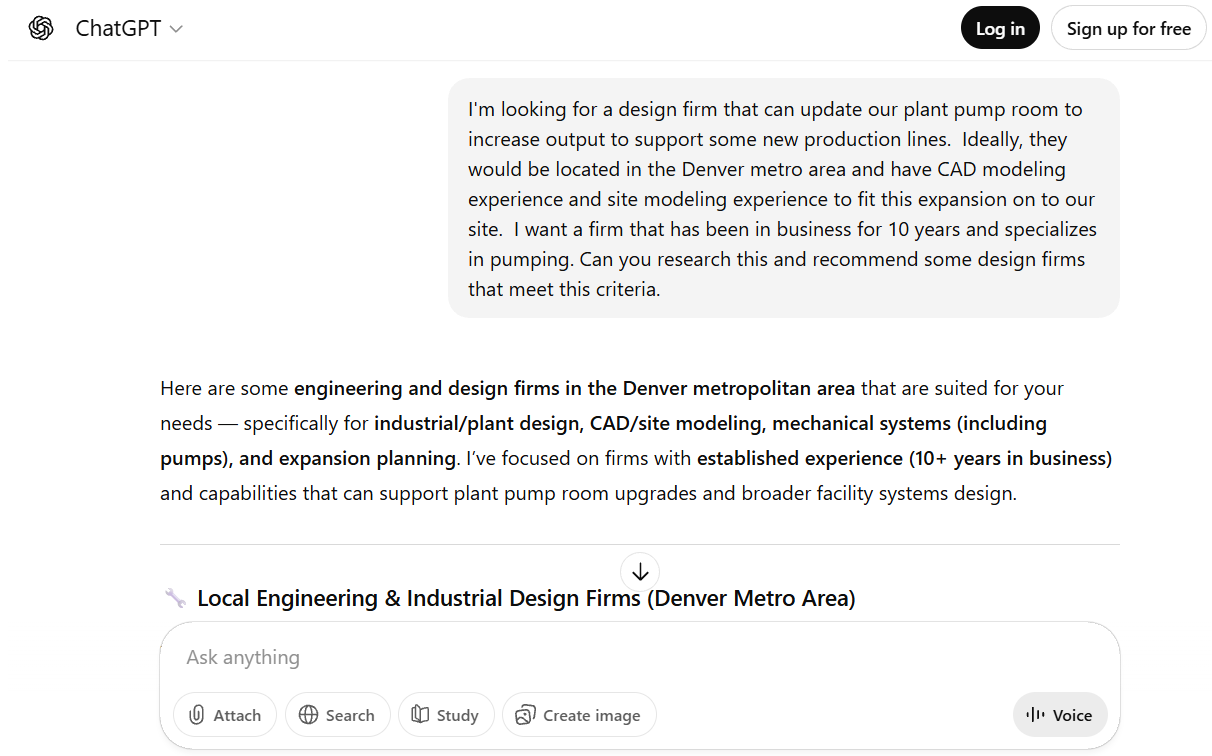
Generative Engine Optimization (GEO) is our term for aligning your website with how AI systems evaluate credibility and reference your web pages.
It is not abandoning SEO – its in-addition to SEO.
It is evolving beyond keyword density and ranking tricks.
GEO focuses on:
- Expressing real-world experience clearly
- Structuring topics around decisions, not products (Q&A)
- Connecting related expertise through intentional internal linking
- Demonstrating expertise and judgment instead of broadcasting claims
We have been building authority-driven digital systems in technical markets through our Revenue-Driven Marketing framework long before AI search became mainstream.
From Keywords to Understanding: What Changed
Think about how you use AI tools like ChatGPT.
You don’t type in isolated keywords.
You ask complete questions:
- “What local firms can re-engineer my pump station?”
- “Who understands this problem?”
- “What usually goes wrong in this situation?”
- “What should I watch out for?”
- “Who should we talk to?”
AI systems evaluate websites in a similar way.
They do not simply match keywords.

They analyze:
- Whether a site demonstrates real operating experience and expertise
- Whether tradeoffs are explained clearly
- Whether topics are covered with depth and structure
- Whether related pages reinforce each other logically
- Whether the company sounds like it has actually solved the problem
This is a different model of discovery.
And most technical company websites were not built for it.
Dive deeper with these in-depth pages: Web Marketing Tactics, How We Work Together, and Google Ads.
How to Tell If Your Site Is Built for AI Discovery

You may want to evaluate your current site if:
- It focuses heavily on products and features, but rarely addresses tradeoffs.
- It ranks for some keywords, yet qualified inbound conversations are inconsistent.
- Marketing activity is visible, but revenue impact feels unclear.
- You have a sense that buyers are researching differently than they were three years ago.
None of this implies failure.
It reflects a change in how buyers educate themselves.
Many leadership teams feel this shift before they can articulate it.
Getting Started Does Not Require a Full Overhaul
One common concern is that adapting to AI-driven search requires rebuilding everything.
It does not.
In most technical companies, meaningful progress begins with focused, manageable adjustments:
- Clarifying one core decision topic with depth and tradeoffs
- Strengthening internal links between related expertise pages
- Rewriting key pages to sound like a guide rather than a brochure
- Replacing generic claims with operating insight
- Adding a few pages that are AI optimized

These are not massive projects.
They are disciplined refinements.
Often, the companies that begin making these adjustments early gain a quiet advantage — because AI systems surface true expertise faster than competitors expect.
The goal is not to rebuild your website overnight.
The goal is to begin aligning it with how serious buyers — and AI systems — now evaluate credibility.
Why This Matters for Revenue
AI systems are increasingly shaping shortlists before sales conversations begin.
When buyers ask nuanced questions, some companies are surfaced repeatedly.
Others are not.
That difference compounds quietly over time.
If something about your current digital strategy feels incomplete, you are probably responding to that early signal.
Who This Is For
This approach is a fit for:
- CEOs and founders who sense opportunity is being missed
- Sales leaders who want better-qualified conversations
- Companies selling complex, consultative technical solutions
- Organizations willing to refine structure instead of chase volume
- Business leaders prepared to step slightly outside their comfort zone to create a real competitive advantage
Adapting to AI-driven discovery does not require recklessness.
It does require clarity — and the willingness to improve a system that may feel “good enough” today, but will not stay that way.

The Bottom Line

AI search is not a trend.
It is a structural shift in how buyers evaluate technical solutions.
You do not need panic.
You do not need hype.
You need clarity, structure, and a disciplined starting point.
If you want to understand where your company stands — and what practical first steps would begin moving you forward — schedule a working session.
If this resonates, reach out.
We will approach it calmly, directly, and without ego.
Continue the evaluation: